$ cat year-2023-reflection.md
# Year 2023 Reflection: First Start-Up
Bought and sold a car, started a company, and one-year anniversary with my girlfriend.
A crazy amount of events had happened, let's skip the intro.
March - Arrow Meetup
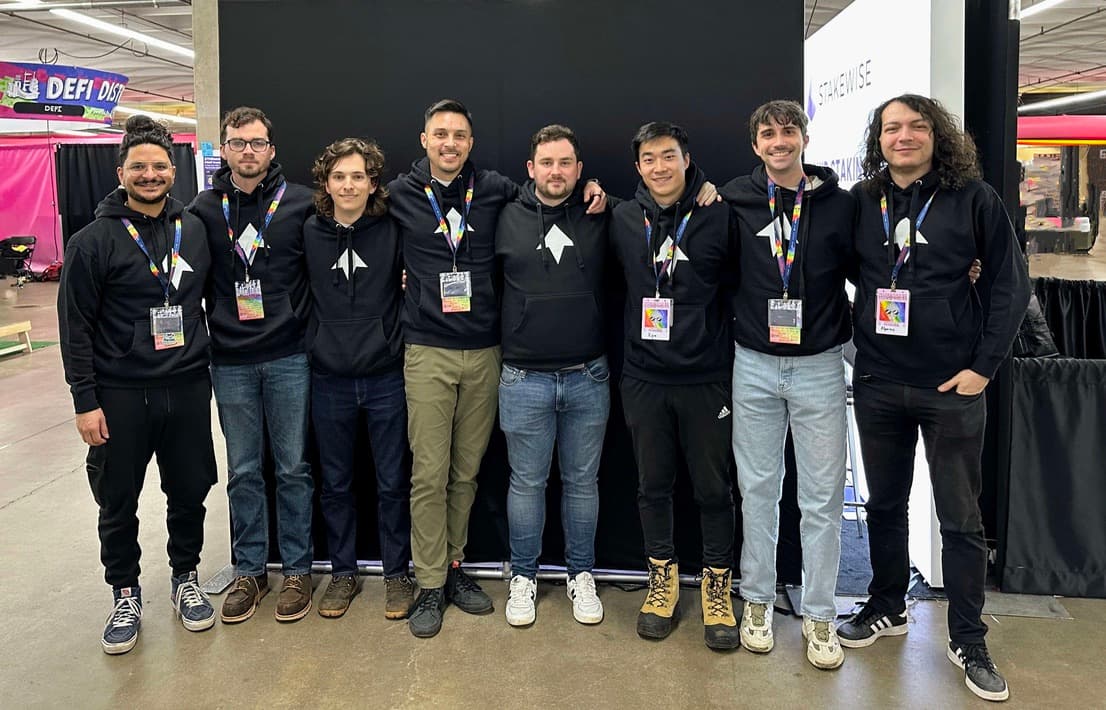
As a member of Arrow Air, I went to Denver, CO for a large event: ETHDenver. It's the first time that Arrow's active contributors have met offline. We got errrks.eth from Alaska, A.M. Smith from San Diego, CA, Thomas and WhiteDadJokes from Texas, sleety from UK, alperenag from Turkey, and deetwo from a mysterious place.
We stayed at an Airbnb and got our Arrow swags (see pic above). During the event, we glad to see that more females were participating what it used to be a male-dominated industry and that there was a significant presence of orgs building for public goods.
It was exciting as we finally got to match the Discord usernames with real faces. I only stayed for 3 days as I had to head back for school.
April - First Car
Driver's License
When I was in New York City, I failed my road test. Manhattan was known for its difficult road conditions and the strict road tests. I completely butchered the parallel parking by not had parked in perfect parallel with the curb.
By contrast, California is way more lenient. I passed the road test in one go. There was no parallel parking at all!
I got my driver;s license primarily for ID purposes. However, thinking that I'd be commuting long-distance from San Francisco to Sunnyvale for my Amazon internship, and it appeared that life could be more convenient, I decided to buy a car.
Shop for a Cheap Car
Now, here came the most excruciating shopping experience. There were so many models, builds, configurations. I had to make so many decisions regarding comfort, budget, fuel economics, etc.
First, the budget. I assessed my financial situation and decided that $30k was my ceiling. Then, the brands. I heard many good things about Japanese cars like Toyota and Honda, about how long-lasting, low-maintenance and fuel efficient they were.
Except that none of them fit my budget.
I thought Japanese cars would be cheap, but that's not the case for the Bay Area. I figured that it was probably because everybody wanted them, so the law of supply-and-demand pushed up the price. What's more insane was that used Japanese cars were more expensive than the new ones! This was because there's a shortage and many had to wait for months to get a new car.
I went to a Toyota dealership and test-drove the only new car left in inventory: a Toyota Corolla. I was quite confused as to why it's so in-demand because it was a terrible driving experience. Me who just suffered from a back injury couldn't stand the thought of driving in that plastic box for 2+ hours a day for my internship.
Shop for a Cheaper Car
After some research, I went to a BMW dealership. I always thought that cars like BMW were out-of-touch. Surprisingly, the used ones were pretty cheap — way cheaper than the Japanese cars that ironically had a reputation for being cheap.
I got my eyes on a 2020 X1. It's a black SUV with premium package: HUD, heated leather seats, etc. with a 40k mileage for $27k. I test drove it. It was a 10x experience for someone who just test drove a Toyota.
I felt like I was driving a spaceship: the controlling was so smooth, and the HUD was so futuristic (even though, now I knew X1 was actually the lowest tier). I immediately proceeded to the purchase process. However, they weren't able to offer me a loan due to my visa status and the next day when I decided to pay upfront, the car was sold to someone else.
Back to the search. This time, a friend of mine took me to a Mercedes dealership to test drove a 2020 C300. It's a sedan that didn't have HUD but the interior was quite ahead of its time. I was exhausted from the shopping process so I decided to just go with it.
It was retailing for $30k, and I bought a maintenance plan and warranty with it, bringing total price to $40k. It's above my budget but I was able to get a loan from Mercedes and was told that the maintenance plan and warranty can be sold back to the dealership.

Regrets and Opportunities
Once my excitement receded, I felt stressed. I ignored other costs came with the car: insurance, the sky-high fuel price (I had to use the premium gas, which was around $6/gal at that time), penalties for parking at the wrong places or at the wrong times, and most importantly, my health.
I realized that my typical day had become either sitting in the car or sitting in the office or sitting at home. Fatigue and lower-back pain soon became daily.
It was a huge relief after I sold the car after 6 months. In total, I spent $17k on the car, which was equivalent to $90 a day.
It wasn't the best financial decision but I got to explore the Bay Area:


… and Taylor Swift's Era's Tour in Santa Clara.

Beyond fun and sceneries, my car also changed my life trajectory.
May - Cofounder
2023 was the year when generative AI took off. There were plenty of hackathons going on in San Francisco. Having a car allowed me to participate in a Microsoft sponsored hackathon: AISF.
I was building an AI motivational speech app during the three-day long hackathon. And in the last day, I was selected to demo the product. That's when I met Eugene Yao, who was working on a AI guided meditation app.
He approached me because he wanted to do something in the wellness space, and my hackathon project resonated with him. Eugene felt that we shared the same passion and was searching for someone technical to build something big.

So, we decided to work on my AI motivational speech app during the summer when he was in New Zealand and I was doing my Amazon internship.
The “trial” period went well for both of us, and we decided to official form a cofounder relationship to build something useful. More on that later.
June - Aug: Amazon Internship
Luck
I got very lucky with this internship.
One year prior, I applied to the summer internship program as soon as it opened because I was panicking that the tech industry was experiencing layoffs. And as soon as I got Amazon's email for an online assessment, I started feverishly study all the past Amazon coding problems leaked online, and was doing LeetCode all day long.
I was lucky that the online assessment consisted of the same exact problems that I already practiced. So I was invited for the final round with an engineer.
I was lucky that the interviewer did not ask me any algorithm questions that were commonly expected. Instead, he just asked me something so easy that my answer "just use a hashmap" was sufficient.
Another friend of mine who also got an offer from Amazon told me that he was asked a dynamic programming ("hell”) question. His interview was scheduled only one month after mine. Early birds do eat worms.
What I did
I was assigned to a confidential project that's related to building a new product related to FireTV. When I joined, the codebase was new and small. Everything was easy to understand and teammates were still figuring out basic things like code structures.
It was a fullstack project, meaning I was responsible for building the user interface as well as the backend and for connecting the two. It wasn't difficult but as a large company, a considerable amount of time was spent on documentation and code styles.
I went through very robust code reviews to ensure that my code can be used in the real world. At the end of the internship, my codes were merged into the production codebase.
Learnings
However, I was appalled by the excessive processes and reviews for a new project. It appeared that big companies were shooting themselves in the foot by being big. It was near impossible to push new features/products to the world without getting through layers of approvals, comments, politics, etc.
An ocean of “nits” on my projects was more than enough for me to remember never to build a company that ends up like today's big techs. The problem was from ill-conceived KPIs that prompted employees to pump out zero value work for the sake of keeping their job or for climbing up the corporate ladder.
If I were to restructure the company, I would get rid of the ladder itself: a super flat org structure that compensate managerial and “do” positions equally. The more layers between an intern to the CEO, the closer a company to become IBM.
Sep: One-Year Anniversary
I fell in love in Sep, 2022 with my girlfriend, Nataliya. It was my first romantic relationship and it had been a very rewarding journey.
Rediscover Myself
It was a bumpy ride. We fought many nasty fights. We pushed and pulled each other. But overall, we both learned something and improved our selves.
I wasn't aware of many flaws in the way I interacted with other people, and this relationship made me see those flaws sharp and clear.
For example, I wasn't aware that the way I said things had unwanted effects. My sarcasms were often interpreted as serious criticisms. No one would point out these problems but Nat did a great job of making me see it and correct the course.
Living together meant that I was finally able to acknowledge and tolerate different, if not opposing, individualities. It made my heart bigger, my temper tamer, and patience more. One interesting note, I reduced my caffeine consumption after finding out that I tended to get more anxious and easily annoyed after drinking coffee.
Women
Spending intimate time with a girl made me see how our world had made it difficult for women to succeed. There's period, which many places still considered a taboo topic. It's painful and the hormonal effects lasted weeks. The corporate world still refused to accommodate this biological bane. Making it worse, over-progressive western society perceived period leave as a sign of weakness and, ironically, sexist (“Women are not weak. We can still work while on period so we don't need special treatments”).
It's relieving to see countries like India were making period leave into legislation. I hoped to see more countries do the same sooner.
Personality
One activity we enjoyed was to identify tech bros on the street. “Tech bro” was a personality, or the lack of it. San Francisco was the HQ of tech bros because here, the lack of personality and extreme minimalism were celebrated as must-haves for those who aspired to change the world.
The Bay Area had a different vibe. Coming from Manhattan, one word to describe Silicon Valley was “dead”. Everyone's weekend activity was hiking, if not coding. This and the spread-out landscape gave me an intense ennui (I've gotten used to it now, and found joy in my weekly bakery trip to Arizmendi).
I'd been to multiple “tech parties” in SF and found it a common sight of two people staring at each other in silence for minutes. Everyone wanted to build startups but many should build themselves first.
I was a borderline tech bro, too. My entire wardrobe could fit one small luggage and you could only find black, gray, and white. Thanks to Nat, I reclaimed my personality. Now I dressed like a Gen-Z.
Many would argue that a lack of personality was the sacrifice needed to change the world. But they failed to understand that the world is made up with people. Tech bros who actually ended up changing the world did not bring any positive value or beauty but only toxicity (Facebook, Web3, Metaverse, etc. The only exception I could think of was Google).
To change the world is to dream big while not losing touch with reality.
Sep - Now: My First Startup
Eugene and I started working on the motivational speech app during the summer. However, that direction didn't seem to be too great as AI voice generation had its limit and we were not sure the product met a real world problem.
So, we went back to square one and started problem discovery. This was a missing step for many of my side projects. I was, like many tech bros, excited to build something that sounded cool but no one wanted to use.
Eugene, having founded a startup, saved us many unnecessary mistakes. We stopped jumping into coding and was meeting daily to clarify problems that were relatable to ourselves and that we're passionate about solving.
First Attempt
We found that many people suffer from procrastination, which led to stress and overwhelm when deadlines drew nigh. Initially, we thought a solution was to break down big tasks into manageable chunks.
This was a well-researched technique called “microtasking”. With the rise of generative AI, we thought that it's a good timing to work on microstasking. Plus, an AI product would be easier to get funded.

Our product asked users to input their tasks, choose a duration, and add additional context, then GPT would spit out a todo list of small steps that would lead users to complete their tasks.
People liked the UI/UX but we quickly found out intensive editing was needed to modified the AI generated list. No matter how we prompted the AI, we couldn't make it consistently output high quality and accurate lists.
The lack of control over the AI eventually led us to pivot away from AI. The most valuable feature from the product was the editor. So, we decided to make it a non-AI product.
The Story about Forget
The idea was simple. You wrote down your daily todo items on the list, then you could enter the “focus mode” with a click of a button which would display the current task with a visual banner that expanded with the progress of time.
We also discovered a way to have Chrome popping out of a window that always stays on your screen. This addressed the “out of sight, out of mind” problem ubiquitous to people with ADHD — who happened to be our target user group.
We made mistakes of jumping ahead of ourselves by wanting to build out more features that sounded cool, scalable, or theoretically would bootstrap network effect. The result was a low retention.
Currently, the product was called “Forget” to make it sound less toxic as a productivity tool and more consumer friendly. In the early days, we'd do Reddit launches to share the tool as a way to acquire users.
However, this was not a scalable strategy and our product didn't have any moat. Toward the end of the year, Eugene started creating short-form videos on social media platforms. And now we're seeing this investment paying off: 1) his Instagram follower counts were growing quickly to almost 100k and 2) about 30+ new sign-ups to the product everyday.
As we gained more users, I got more and more product feedback. People wanted all sorts of things. But this was the real danger. If we didn't have a strong filter to say no to many of the feedback, our product would look like something we tried not to be: yet another business productivity tool with cluttered UI and overloaded features.
The product had to be attractive. This was the core of our product strategy. Design was a first-class citizen that triumph over other factors whenever there's a conflict. Our thesis was that a beautiful UI would earn us some free passes to compensate for the stuff we compromised. This was also true in the real world (just think about the dating).
Onward
As of writing, we're preparing to raise a pre-seed round. With the current MVP, we have validated the market and are ready for building out a more refined product. So, I will be spending less time on coding, more on designing and innovating. Eventually, we'd like to have some experienced developers to build out a robust product.
Closing with Scott Gallaway's sign-off: life is so rich.